Quick answer
The cost of making a garment in India is the sum of a cost sheet: fabric (usually the largest single line), cutting and stitching (CMT), wash, print or embroidery, trims and labels, packing, the factory's overhead and margin and, for exports, inland freight and documents. Together these make the FOB price. Published Indian figures for a plain 180 GSM cotton T-shirt at 500 pieces run from about ₹80 to ₹250 per piece. In our worked example, a pair of wide-leg jeans at 100 pieces comes to about ₹824 FOB (about USD 9 to 10). Small make-to-order runs of 25 to 100 pieces cost more per piece than bulk. Freight, duty and taxes in your country come on top.
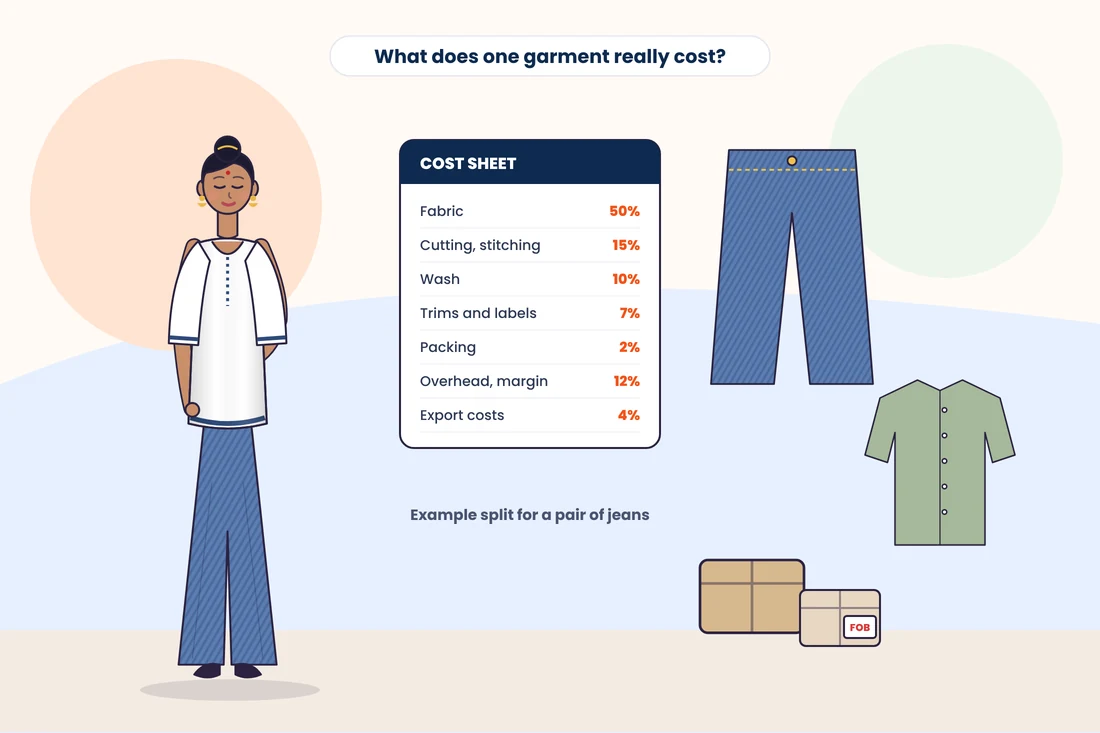
"How much does it cost to make clothes in India?" is the first question most brands ask, and the honest answer is: it depends on the fabric, the design and the quantity. That answer is not much use when you are planning a budget. This guide shows how Indian garment factories actually build an export price, line by line, so you can estimate your own cost, read a factory quote with confidence and know which levers lower it.
It is written for brands, boutiques and online sellers abroad who order make-to-order clothing from India, and for factories in Surat and Ahmedabad that want to quote export buyers clearly.
Contents
- The garment cost sheet, line by line
- Fabric: consumption and price
- Worked example: jeans, 100 pieces
- What published Indian figures say: T-shirts
- Why small runs cost more per piece
- From FOB price to landed cost
- Seven ways to lower your cost
- How to read a factory quote
- Getting a make-to-order quote through BizTorq
- FAQs
The Garment Cost Sheet, Line by Line
Indian export factories price a style with a cost sheet. The lines are the same for almost every garment; only the amounts change.
| Cost line | What it covers | What makes it go up |
|---|---|---|
| Fabric | Metres (woven) or kilograms (knit) per piece, plus cutting waste, times the fabric price | Heavier or premium fabric, custom colours, wide shapes, large sizes, checks that need matching |
| CMT (cut, make, trim) | Cutting, stitching, finishing, checking and pressing, usually priced from the stitching time (SMV) | More panels, pockets, topstitching, pleats and fine details |
| Wash, print or embroidery | Denim washes, garment dyeing, screen or digital print, embroidery | Complex washes, multi-colour prints, large embroidery areas |
| Trims | Zips, buttons, rivets, thread, interlining, elastic, drawcords | Branded or custom trims, metal hardware |
| Labels and tags | Brand, size, care and content labels, hang tags | Woven labels, custom tags, extra languages |
| Packing | Folding, polybags, tissue, export cartons | Individual boxes, hangers, special packing |
| Overhead and margin | Factory running costs, sampling, rejections and profit, often a percentage | Small runs, short deadlines, many colours and sizes |
| Export costs | Inland freight to the port or airport, customs agent, export documents | Small shipments, urgent air dispatch |
The total is the factory's FOB price: goods cleared for export and handed over in India. If you are new to the term, read FOB vs CIF vs DDP.
Fabric: Consumption and Price
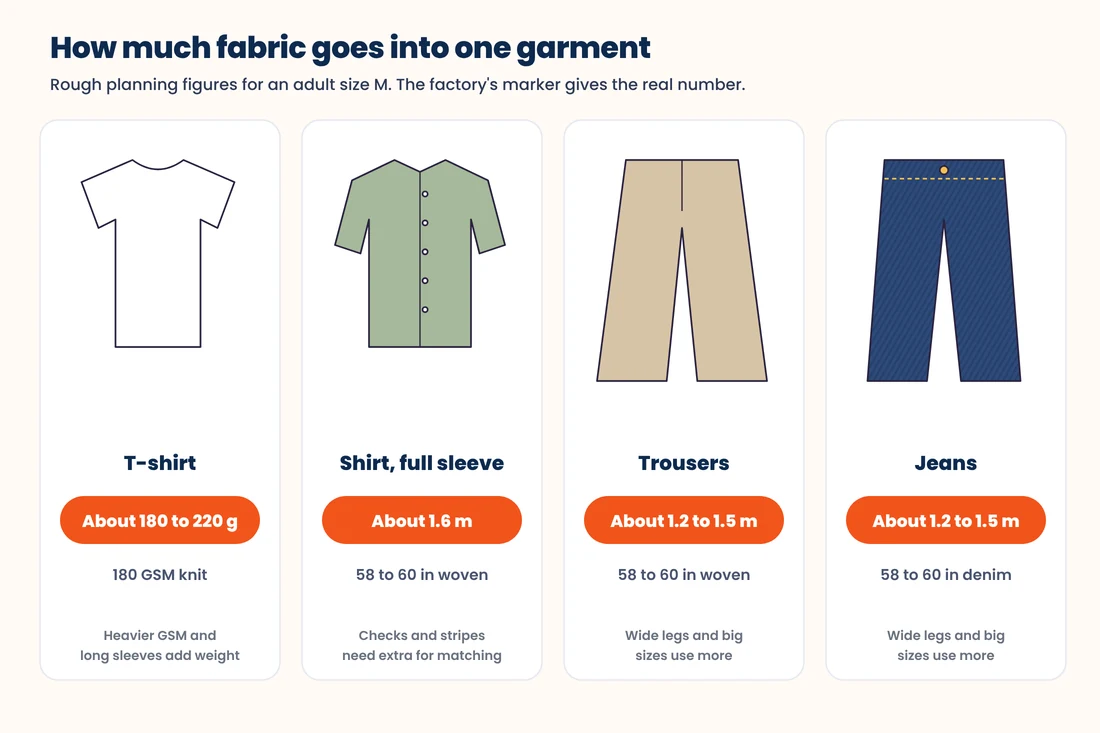
Fabric is normally the biggest line, so get two numbers right: how much fabric one piece uses (consumption) and what the fabric costs.
- Woven garments are measured in metres at a given width. A full-sleeve formal shirt needs about 1.6 m of 60-inch fabric, or about 2.1 m of 44-inch fabric.
- Knit garments are measured by weight. A 180 GSM T-shirt uses about 180 to 220 g of fabric, and cotton jersey of this weight is quoted at about ₹200 to ₹350 per kg in published Indian costings.
- Trousers and jeans commonly need about 1.2 to 1.5 m of 58 to 60 inch fabric for an adult size M; wide-leg and large sizes need more.
- Add cutting waste, often around 5%, and more for prints and checks that must match.
Fabric prices change with cotton prices, season and quantity. Stock fabric from a mill or market is cheaper and has low minimums; custom-dyed or custom-printed fabric needs a minimum run, often many hundreds of metres. For fabric checks, see the fabric quality guide, and for Surat printing and dyeing costs, the digital printing and mill dyeing guide.
Worked Example: Wide-Leg Jeans, 100 Pieces
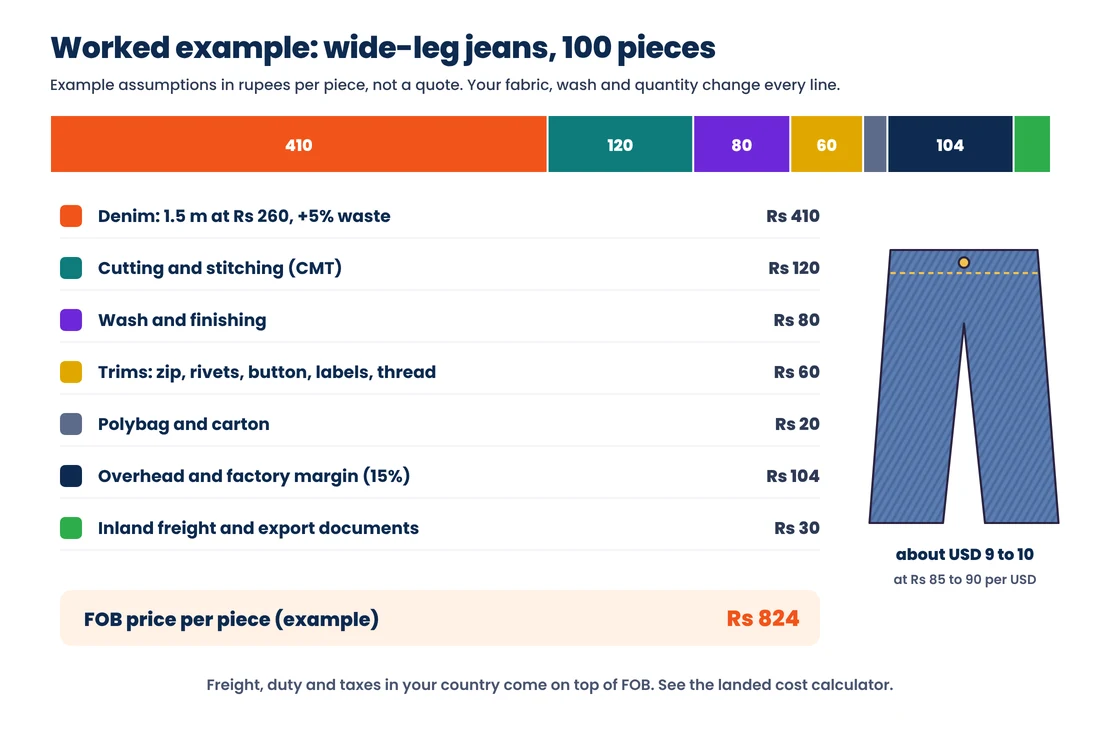
Here is how the lines add up for a simple pair of wide-leg jeans with a basic wash, made in a run of 100 pieces. Every number is an example assumption to show the method; use your factory's figures for your own budget.
| Line | Example assumption | ₹ per piece |
|---|---|---|
| Denim | 1.5 m at ₹260 per metre, plus 5% waste | 410 |
| Cutting and stitching (CMT) | Five-pocket wide-leg jean | 120 |
| Wash and finishing | Basic rinse or stone wash | 80 |
| Trims | Zip, rivets, shank button, labels, thread | 60 |
| Packing | Polybag and share of export carton | 20 |
| Overhead and factory margin | 15% of the lines above | 104 |
| Export costs | Inland freight, customs agent, documents | 30 |
| FOB price | 824 |
At about ₹85 to ₹90 to the US dollar, that is roughly USD 9 to 10 per pair FOB. The biggest levers are the denim price and the wash: an acid, laser or heavy distressed wash can add far more than the basic wash shown here. For more on small denim runs, read low MOQ jeans manufacturing in India.
What Published Indian Figures Say: T-Shirts
T-shirts are the easiest garment to compare because the cost lines are simple. Two Indian manufacturers that publish costings give these figures for plain cotton tees at around 500 pieces:
| Line | Published range (₹ per piece) |
|---|---|
| Fabric, 180 GSM combed cotton | 36 to 77 |
| Cutting, stitching and overhead | 20 to 50 |
| Screen print, 1 colour front | 15 to 50 |
| Labels, hang tag and polybag | 10 to 25 |
| Typical total, plain tee | 80 to 250 |
| Another maker's quote: 180 GSM, 25s combed cotton, labels and export carton included | 200 to 220 |
The gap between the two shows why you should never budget from one number found online: yarn quality, fit, finishing and what is included all move the price. Ask for a cost breakdown with every quote.
Why Small Runs Cost More per Piece
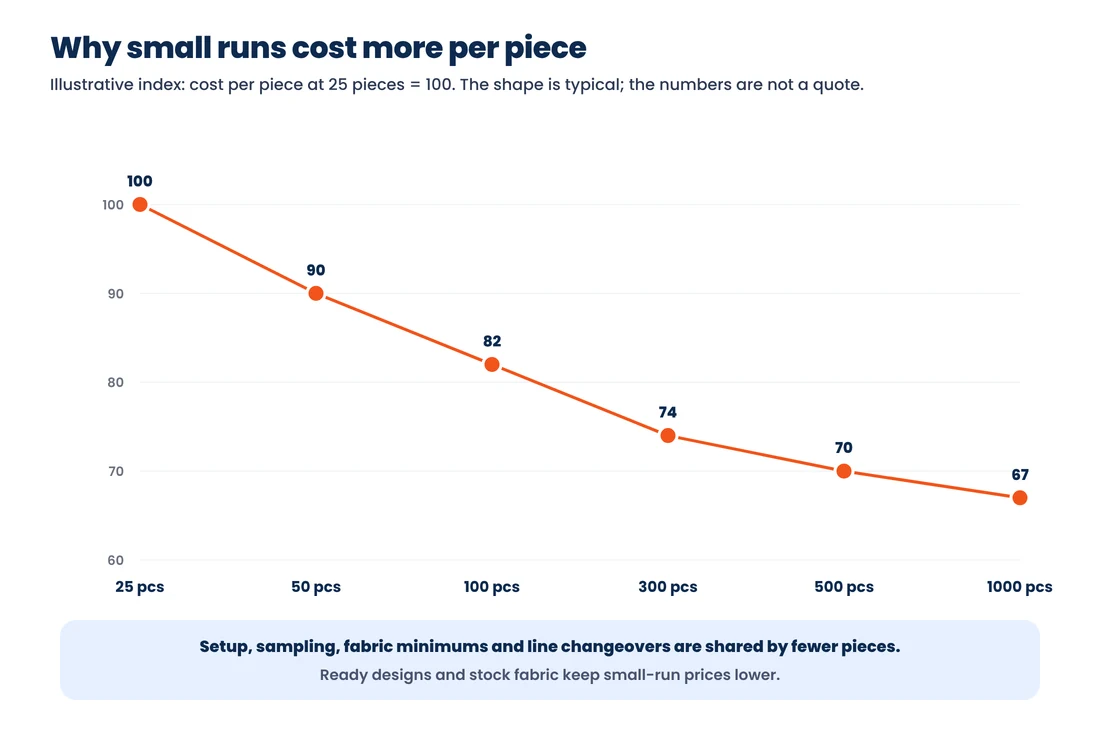
Make-to-order lets you start from about 25 pieces per design, but the per-piece price is higher than for 500 or 1,000 pieces. The reasons:
- Setup is shared by fewer pieces: pattern grading, the cutting marker, machine setup and the line changeover cost about the same for 25 pieces as for 500.
- Fabric minimums: mills and markets sell by the roll or set minimums, and leftover fabric is built into the price.
- Lower efficiency: operators reach full speed after the first few dozen pieces, and a short run ends before they get there.
- Trims and labels: custom labels and tags have their own minimum quantities.
The way around it is to start from designs the factory already makes, in stock fabric, as with the ready make-to-order designs, and to reorder your best sellers in larger runs.
From FOB Price to Landed Cost
The FOB price is what you pay the factory. Your real cost per piece in your own warehouse, the landed cost, also includes:
- air or sea freight and cargo insurance;
- destination port or airport charges and the customs broker's fee;
- import duty and tariffs, which depend on the garment, fabric and your country;
- import VAT, GST or sales tax (often reclaimable if you are registered);
- delivery to your warehouse, plus samples and inspection.
Work it out with the landed cost calculator and estimate duty with the export duty calculator. On the Indian side, exports are zero-rated for GST: an exporter can ship under a Letter of Undertaking (LUT) without charging IGST on the export invoice.
Budget for inspection too. A pre-shipment check costs far less than a bad shipment; see the AQL 2.5 inspection guide.
Seven Ways to Lower Your Cost per Piece
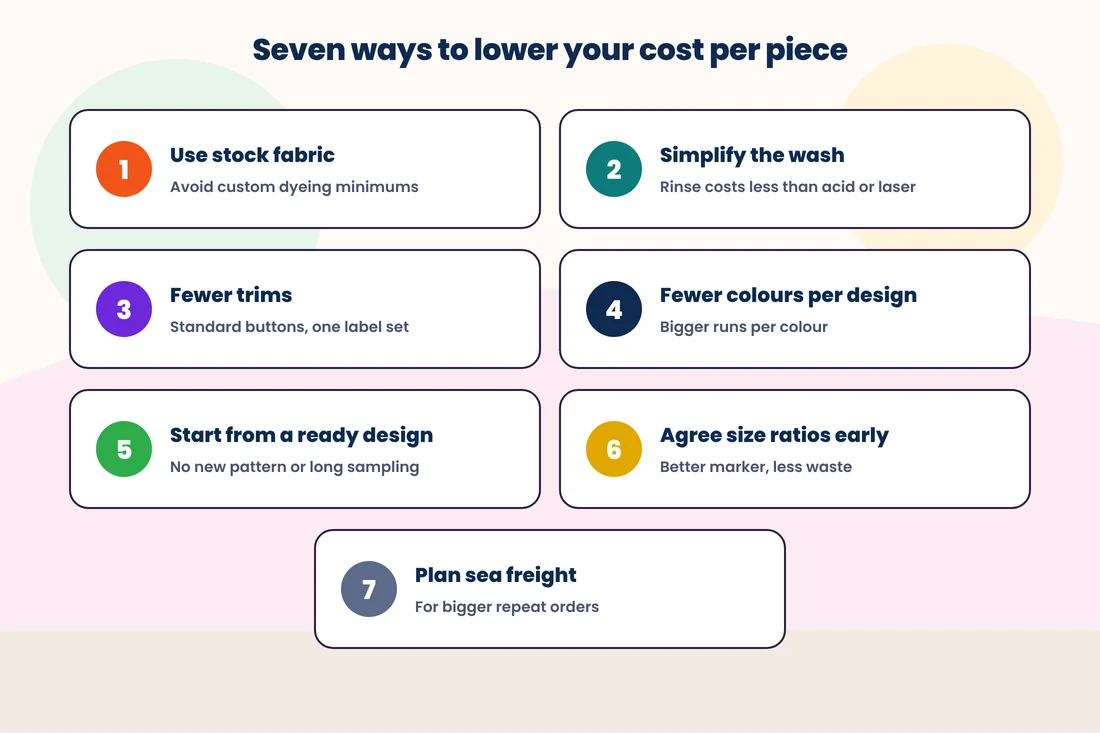
- Use stock fabric. Custom dyeing and printing carry minimums and lead time.
- Simplify the wash or print. A rinse wash or a one-colour print costs much less than acid, laser or all-over print.
- Cut trims you do not need. Standard buttons and one woven label set add less than branded hardware and many tags.
- Order fewer colours per design. Two colours at 50 pieces each usually price better than five colours at 20.
- Start from a ready design. No new pattern, fewer sample rounds and a factory that already knows the style.
- Agree size ratios early. A planned size split lets the cutting marker use fabric better.
- Plan ahead and ship by sea for larger repeat orders; air freight can cost more than the garment's wash and trims together.
A clear tech pack also lowers cost, because the factory prices exactly what you want instead of adding a safety margin for guesswork.
How to Read a Factory Quote
Before you compare two quotes, check that they price the same thing:
- Shipping term and place: FOB Nhava Sheva, FCA Mumbai airport, CIF or DDP. Compare on landed cost, not on the headline price.
- Fabric: composition, weight (GSM or oz), width and whether it is stock or custom.
- What is included: wash, print, labels, hang tags, packing, export cartons.
- Quantity breaks: price at 25, 50, 100 and 300 pieces, so you can plan reorders.
- Sample terms: sample cost, whether it is credited on bulk, and the number of rounds.
- Lead time and payment: sample and bulk days, advance percentage and when the balance is due.
- Validity: how long the price holds, because fabric prices move.
Ask for a line-by-line cost breakdown. A factory that shares its cost sheet is usually easier to work with, and you can see exactly what a design change will save. Before paying, read how to verify a supplier.
Getting a Make-to-Order Quote Through BizTorq
On BizTorq make-to-order, you send one brief and receive a written quote from verified garment factories in Surat and Ahmedabad, usually within about 2 working days. You then contract and pay the factory directly. To get an accurate price first time, include:
- the product, with photos or a tech pack;
- fabric preference, or "factory to suggest";
- quantity per design and colour, and your size split;
- wash, print, embroidery and label needs;
- target price per piece and your destination country;
- preferred shipping term (FOB, FCA, CIF or DDP) and your launch date. The timeline planner helps you set it.
To skip pattern-making and sampling time, browse the ready designs from 25 pieces, or the 2026 lookbook. For a full plan, including budget, read how to start a clothing brand with an Indian manufacturer, and for your country's import rules, see the guides for the USA, UK, Canada, Australia and UAE.
Frequently Asked Questions
How much does it cost to manufacture clothing in India?
It depends on fabric, design and quantity. Published Indian costings put a plain 180 GSM cotton T-shirt at about ₹80 to ₹250 per piece at 500 pieces. In our worked example, wide-leg jeans at 100 pieces come to about ₹824 FOB, roughly USD 9 to 10.
What is a garment cost sheet?
A line-by-line breakdown of a garment's price: fabric, cutting and stitching (CMT), wash or print, trims, labels, packing, overhead and margin, and export costs. The total is the factory's FOB price.
What is the biggest cost in making a garment?
Usually the fabric. It often makes up around half of the FOB price for woven garments such as jeans and shirts, which is why fabric choice and consumption matter most.
What does CMT mean in garment manufacturing?
Cut, make and trim: the factory's charge for cutting, stitching, finishing, checking and pressing. It is usually priced from the stitching time, so more panels and details cost more.
How much fabric is needed for a shirt or jeans?
A full-sleeve formal shirt needs about 1.6 metres of 60-inch fabric. Jeans and trousers commonly need about 1.2 to 1.5 metres of 58 to 60 inch fabric for size M. The factory's marker gives the exact figure.
Why does a small order cost more per piece?
Setup, sampling, fabric minimums and line changeovers are shared by fewer pieces, and operators do not reach full speed on a short run. Ready designs and stock fabric keep small-run prices lower.
Is FOB price the final cost to import clothes?
No. FOB covers the goods cleared for export in India. Freight, insurance, broker fees, import duty, taxes and delivery in your country come on top. Use the landed cost calculator.
Is GST charged on clothing exported from India?
Exports are zero-rated. A registered exporter can ship under a Letter of Undertaking (LUT) without charging IGST on the export invoice. Import taxes in your own country still apply.
How can I reduce the cost of manufacturing clothes in India?
Use stock fabric, simplify the wash or print, cut unneeded trims, order fewer colours per design, start from a ready design, agree size ratios early and ship larger repeat orders by sea.
Should I ask a factory for a cost breakdown?
Yes. A line-by-line breakdown shows what is included, lets you compare quotes fairly and shows how much a design change would save.
How much does a garment sample cost in India?
Sample terms vary by factory. Some charge a fee that is credited against the bulk order; others charge only for courier. Ask for sample cost, rounds and credit terms in the written quote.
What is the minimum order for make-to-order clothing in India?
Many make-to-order factories on BizTorq start from about 25 pieces per design, depending on the factory, fabric and design.
How do I get a quote from an Indian garment factory?
Send a brief on BizTorq make-to-order with the product, fabric, quantity, sizes, finishes, target price, destination and shipping term. You get a written quote, usually in about 2 working days.
Get a Clear, Line-by-Line Quote
Send your brief through make-to-order enquiry and ask for a cost breakdown, then check your full cost with the landed cost calculator.
Are you a garment factory in Surat or Ahmedabad? List your factory to receive export briefs from brands abroad.
The jeans example uses assumptions to show the costing method and is not a quote. T-shirt ranges are from costings published by Indian manufacturers in 2026 and vary by supplier. Fabric prices, exchange rates and duty change often; confirm every figure with your factory and a customs broker.