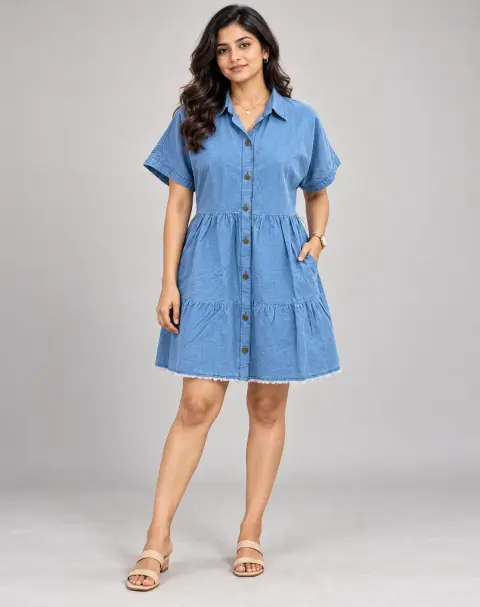
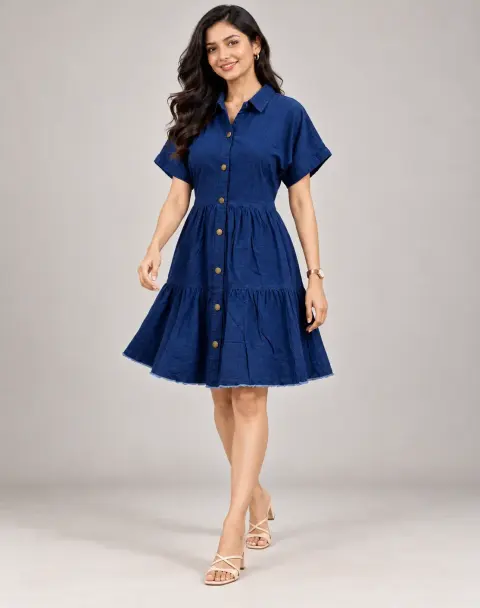
US boutiques and online brands use Indian factories to make dresses that big retailers do not carry, in runs of 25 to 100 pieces per style. Here is how to brief one, what to specify, and what goes wrong.
Quick answer
Yes. Factories in Surat, Ahmedabad and other Indian hubs make dresses to your design, fabric, fit and label for buyers in USA, from 25 pieces per design. You send a brief, receive a written quote in about two working days, approve a sample in 7 to 14 days, and bulk production takes 30 to 45 days, then about 32 to 45 days by sea or 4 to 7 days by air to USA.
The typical buyer is a boutique owner in Texas, California or New York, or the founder of an Etsy, Shopify or Instagram brand. They want prints and silhouettes of their own, so they are not selling the same dress as the shop down the street, and they want to test a style at 25 to 100 pieces before they commit to more.
That suits Indian factories well. Surat is known for printed rayon, viscose and cotton fabrics, and for dresses made from them, and a small factory there can buy the cloth and cut it in the same week.
Send your size chart in US sizes with measurements in inches. Indian factories often grade to Indian or European sizing by default, and a dress that is two sizes off is the most common reason for returns. Ask the factory to make the sample in a mid size and measure it flat against your chart before you approve.
Plan your seasons early. Spring and summer dresses are usually briefed in November to January, and holiday party dresses in July or August. If a drop is tight, send the first small batch by air and the rest by sea.
| Import duty | Most Indian goods pay the base duty for their tariff line plus an extra 10 percent (Section 301) that started on 24 July 2026. The base rate depends on the fibre and the cut. US tariffs have changed several times since 2025, so confirm the tariff line and the rate on your shipment date with your customs broker. |
|---|---|
| Samples | The duty-free allowance for small parcels is suspended, so courier samples are dutiable. Allow for duty and a courier or broker clearance fee on sample parcels. |
| Sales tax | No VAT at import. Sales tax is handled at the point of sale and differs by state. |
| Labels | Fibre content, country of origin marked in English, the name of the US importer or seller (or its FTC RN number), and a permanent care label (US federal textile and care-labelling rules). Only US businesses can hold an RN, so ask the buyer or its broker what to print. |
| Paperwork | The US importer, or its customs broker, files an Importer Security Filing at least 24 hours before sea cargo is loaded, so send the commercial invoice and packing list before the vessel closes. |
| Sizes | US sizing. Women's 0 to 16 or XS to XL is common, and many brands add 1X to 3X. Send measurements in inches. |
| Usual terms | FOB if you have a freight forwarder, CIF or DDP if you want the seller to arrange freight. |
| Transit time | About 32 to 45 days by sea and 4 to 7 days by air, after production. |
Checked November 2026. Rules change, so confirm with your customs broker before you order. Use the duty calculator for an estimate.
Base rates from the 2026 US tariff schedule for woven pieces, plus the extra 10 percent Section 301 duty that most Indian goods have paid since 24 July 2026.
| Cotton dress-style kurta or anarkali (HTS 6204.42.30) | Base 8.4% + 10% = 18.4% of the goods value |
|---|---|
| Rayon or viscose dress-style piece (HTS 6204.44.40) | Base 16% + 10% = 26% of the goods value |
| Polyester or other synthetic dress-style piece (HTS 6204.43.40) | Base 16% + 10% = 26% of the goods value |
| Silk dress-style piece (HTS 6204.49.50) | Base 6.9% + 10% = 16.9% of the goods value |
Checked November 2026. Knitted pieces and other tariff lines have different rates. Formal entries also pay a Merchandise Processing Fee (0.3464%) and, for ocean cargo, a Harbor Maintenance Fee (0.125%). Confirm the tariff line with a customs broker.
Boutiques and wholesalers on these streets are the usual buyers of made-to-order Indian clothing. Each guide lists the markets and what sells.
Yes, many Surat and Ahmedabad factories accept 25 to 50 pieces per design when they use fabric from the market. If you need cloth printed or woven specially for you, the minimum is higher because the fabric mill sets it. Say so in your brief and the quote will show which applies.
Rayon challis, viscose crepe and cotton voile are popular for drape and print, cotton poplin for structure, and linen blends for summer. Ask for the fabric weight and composition in writing and request a wash test.
Yes. Send your artwork as a high-resolution file with the repeat size and colour references. The factory will make a strike-off so you can check colours before bulk printing.
Send a size chart in US sizes with measurements in inches, ask for a sample in a middle size, and compare it flat against your chart. Approve the sample only after you have measured it.
Plan on 12 to 16 weeks from agreed brief to goods in the USA by sea, and 8 to 11 weeks by air. That covers the sample, your review, bulk production and shipping. Use the timeline planner to work back from your launch date.
The importer pays unless you agree delivered terms (DDP) with the seller. US duty on Indian clothing has changed several times, so check the rate on your shipment date with your customs broker, and use the duty calculator for an estimate.