
Ahmedabad Exports & Trade

CII–BCG Report Urges Push Into Finished Garments as Global Brands Eye India Amid Trade Shifts

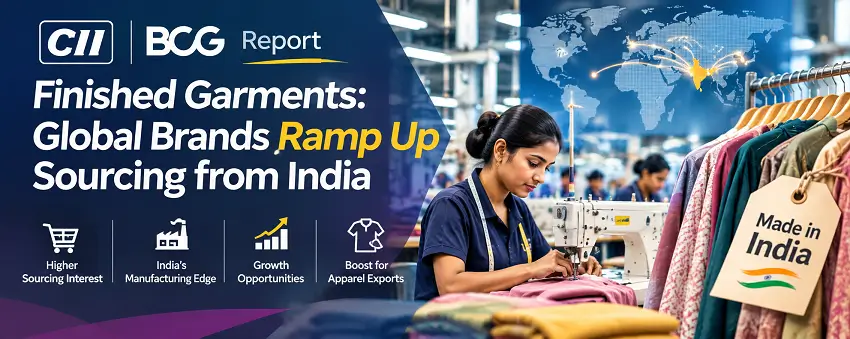
A new CII–BCG report highlights that while India’s April–October textile and apparel exports rose 5.5% YoY to $21.52 billion, expanding finished garment share and vertical integration is vital as global brands explore India amid tariff shifts and trade agreements.

Modern textile manufacturing and custom garment export facility in Gujarat with woven fabric bolts, yarn cones, and quality inspectors

India’s apparel and textile export landscape is at a strategic inflection point as global brands re-evaluate sourcing footprints and new trade agreements reshape market access. According to a CII–BCG report published on 23–24 November 2026, India’s textile and apparel exports rose 5.5% year-on-year to $21.52 billion during April–October 2026, yet India’s global apparel export share remains around 3% with under 1% share in fast-growing categories such as outerwear, sportswear, and knitwear.

Moving Beyond Yarn & Fabric Into Finished Garments

Industry analysis notes that only about 5% to 6% of India’s textile clusters are integrated end-to-end from spinning to garmenting, whereas global competitors rely on tighter supply-chain integration and scale. At the same time, trade reporting on 24 November underscores that shifting tariff structures and trade agreements—including the India–UK Comprehensive Economic and Trade Agreement (CETA)—are prompting international buyers to look closely at Indian suppliers for make-to-order and custom apparel production.

  • Integration Advantage in Gujarat: Manufacturers across Ahmedabad and Surat that pair fabric sourcing and finishing with garment stitching are better positioned to cut lead times and meet overseas buyer standards.
  • Custom & Private-Label Orders: Brands and buyers exploring custom runs can connect with factory partners via TexMandi Make-to-Order and verify tariff lines using the GST & HSN Finder.

What it means for Ahmedabad traders

Garment and fabric manufacturers in Ahmedabad and Surat should invest in end-to-end sampling speed, quality consistency, and product diversification beyond basic commodities to capture overseas buyers shifting orders toward India.

Questions traders are asking

How much did India’s textile and apparel exports reach in April–October 2026?

India’s textile and apparel exports rose 5.5% year-on-year to $21.52 billion during April–October 2026, according to government data cited in late November 2026.

What does the CII–BCG report recommend for India’s textile exports?

The report recommends building manufacturing scale, improving productivity, expanding integrated spinning-to-garment clusters, and moving beyond yarn and fabric into higher-value finished garments.

Why are global brands exploring Indian textile suppliers in late November 2026?

Changes in tariff structures and trade agreements—such as the India–UK trade pact—are encouraging international brands to diversify sourcing toward India.

Sources

Spotted an error? Tell us on WhatsApp.

WhatsApp Us