Quick answer
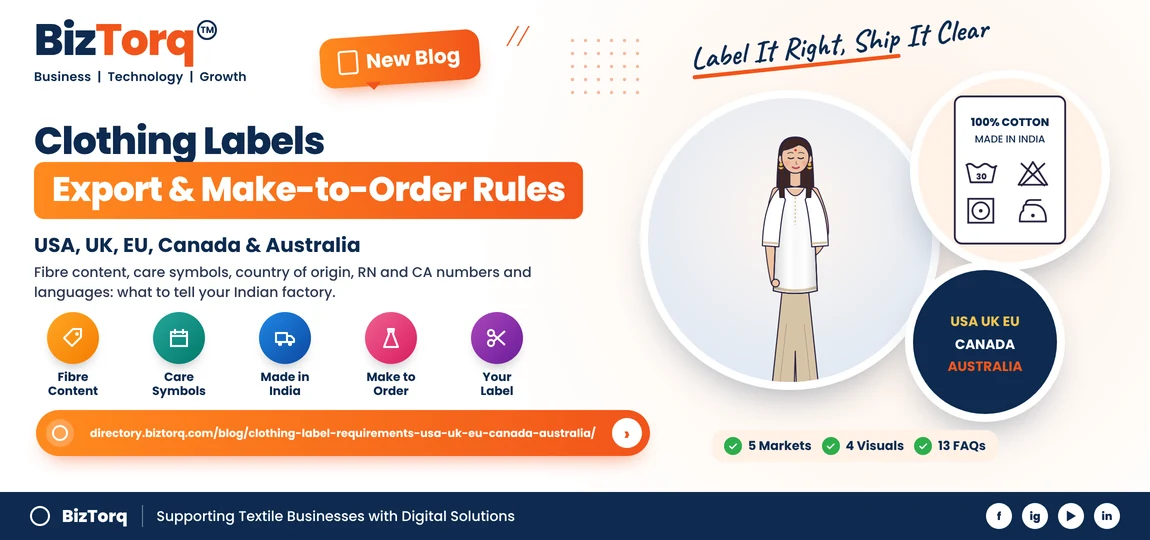
Clothing you import from India must carry labels that meet the rules of the country where it is sold. USA: fibre content, country of origin ("Made in India"), your business name or RN number, and care instructions are all required. Canada: fibre content in English and French, plus your name and address or CA number; care labels are voluntary, and imported goods are expected to show their origin. UK and EU: fibre composition is required (in the local language in each EU country); care labels and origin are voluntary but must be accurate if used; product-safety rules add maker and importer details. Australia: care instructions are mandatory and imported clothing must show its country of origin; fibre content is voluntary. Give your make-to-order factory the exact label text and approve it on the pre-production sample.
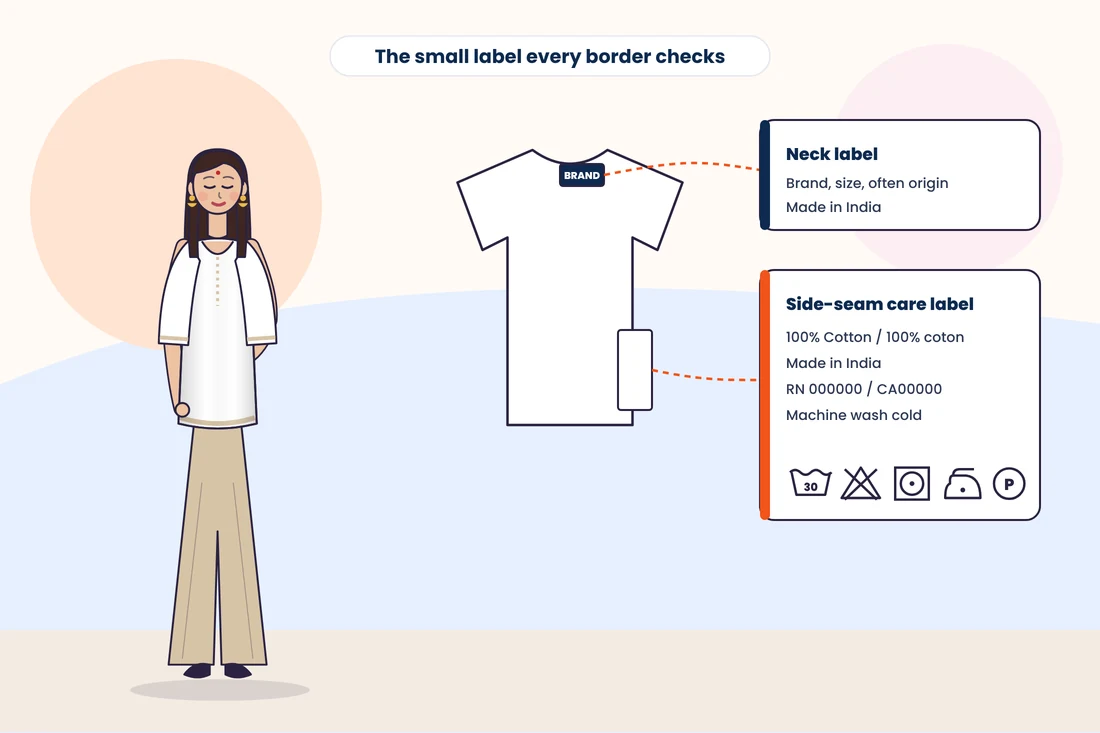
Labels are the cheapest part of a garment and one of the easiest places to go wrong. A missing "Made in India", a fibre name in the wrong language or a care label that does not match the fabric can mean relabelling at your warehouse, a delayed customs release or a fine. Because labels are sewn in at the factory, every detail has to be decided before bulk production starts.
This guide sets out what clothing labels must show in the USA, Canada, the UK, the EU and Australia, how care symbols work, and exactly what to send an Indian garment factory so labels are right first time. It covers adult clothing; children's wear has extra safety rules.
Contents
- Requirements at a glance
- USA
- Canada
- United Kingdom
- European Union
- Australia
- Care symbols explained
- What to send your Indian factory
- Children's wear: extra rules
- Common labelling mistakes
- FAQs
Requirements at a Glance
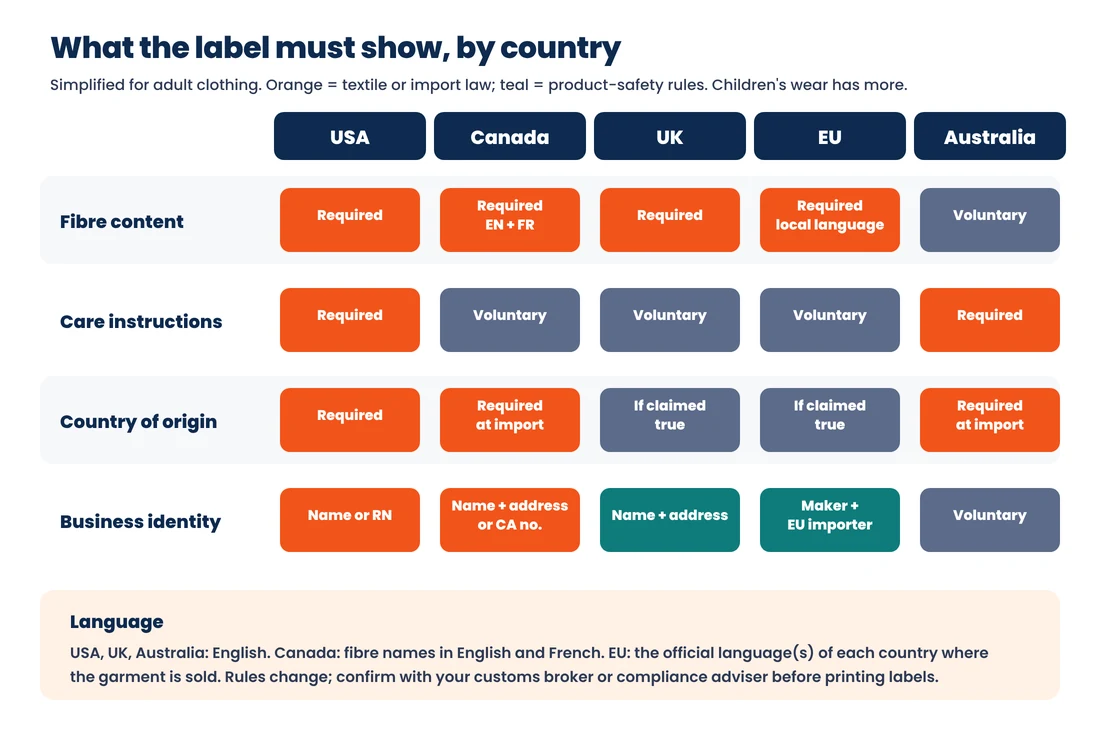
| USA | Canada | UK | EU | Australia | |
|---|---|---|---|---|---|
| Fibre content | Required | Required, English and French | Required | Required, local language | Voluntary (must be accurate) |
| Care instructions | Required | Voluntary (must be accurate) | Voluntary | Voluntary | Required |
| Country of origin | Required | Expected at import | Voluntary, must not mislead | Voluntary, must not mislead | Required at import |
| Business identity | Name or RN number | Name and address, or CA number | Producer details under product safety rules | Manufacturer and EU responsible person under product safety rules | Not required |
| Language | English | English and French for fibre names | English | Official language(s) of each country of sale | English |
USA
US clothing labels are governed by the Textile Fiber Products Identification Act and the Care Labeling Rule, both enforced by the Federal Trade Commission (FTC). Each garment needs a permanent label showing:
- Fibre content by percentage of weight, in order of predominance, using generic fibre names (for example "60% Cotton, 40% Polyester").
- Country of origin, for example "Made in India". On garments with a neck, this goes on a label at the inside centre of the neck.
- Identity of the business responsible: its name, or a Registered Identification Number (RN) issued by the FTC to US businesses.
- Care instructions for regular care, in words or with ASTM care symbols, which must stay legible for the life of the garment.
As the US importer or brand, you normally apply for the RN; the Indian factory prints it on your label.
Canada
Canada's Textile Labelling Act, administered by the Competition Bureau, requires a label with two parts:
- Fibre content, with generic fibre names and fibre information in both English and French, for example "100% cotton / coton".
- Dealer identity: your company name and mailing address, or a CA Identification Number, a five-digit number preceded by "CA" that only Canadian manufacturers, importers and sellers can obtain.
Care labelling is voluntary in Canada, but if you include it, it must be accurate; symbols follow the national care labelling standard. For customs, imported goods are expected to be marked with their country of origin ("Made in India"), and goods sold in Quebec may need more French. Check with your Canadian customs broker before printing.
United Kingdom
In the UK, the Textile Products (Labelling and Fibre Composition) Regulations 2012 require every textile product to carry a label showing its full fibre composition, using only the approved fibre names. The manufacturer or the importer into the UK is responsible.
- Care labels are voluntary but almost universal; most use the international care symbols.
- Country of origin is not required on the label, but any origin claim must be true and not misleading.
- Product safety rules expect the producer's or importer's name and address to be traceable, usually on the label, swing tag or packaging.
European Union
The EU Textile Regulation (EU) No 1007/2011 requires a fibre composition label using the regulation's fibre names, in the official language or languages of each member state where the garment is sold. That is why EU labels often list fibres in many languages. If a garment contains non-textile parts of animal origin, such as leather trims, the label must say so.
- Care labels are voluntary, but standard care symbols are expected by retailers and customers.
- Country of origin is voluntary, and must be accurate if shown.
- Under the EU's General Product Safety Regulation, products need the manufacturer's name and contact details and, for a maker outside the EU such as an Indian factory, an EU-based responsible economic operator, on the product, its packaging or an accompanying document.
Australia
- Care labelling is mandatory under the Consumer Goods (Care Labelling) Information Standard 2023, which applies to clothing and other textiles. Instructions must be in English; symbols may be added.
- Country of origin: imported clothing must carry a trade description including the country of origin under the Commerce (Trade Descriptions) rules, checked at the border.
- Fibre content is not mandatory, but any claim must not be false or misleading under Australian Consumer Law.
For duty and shipping to each market, see the make-to-order guides for the USA, Canada, UK, Germany and Australia.
Care Symbols Explained
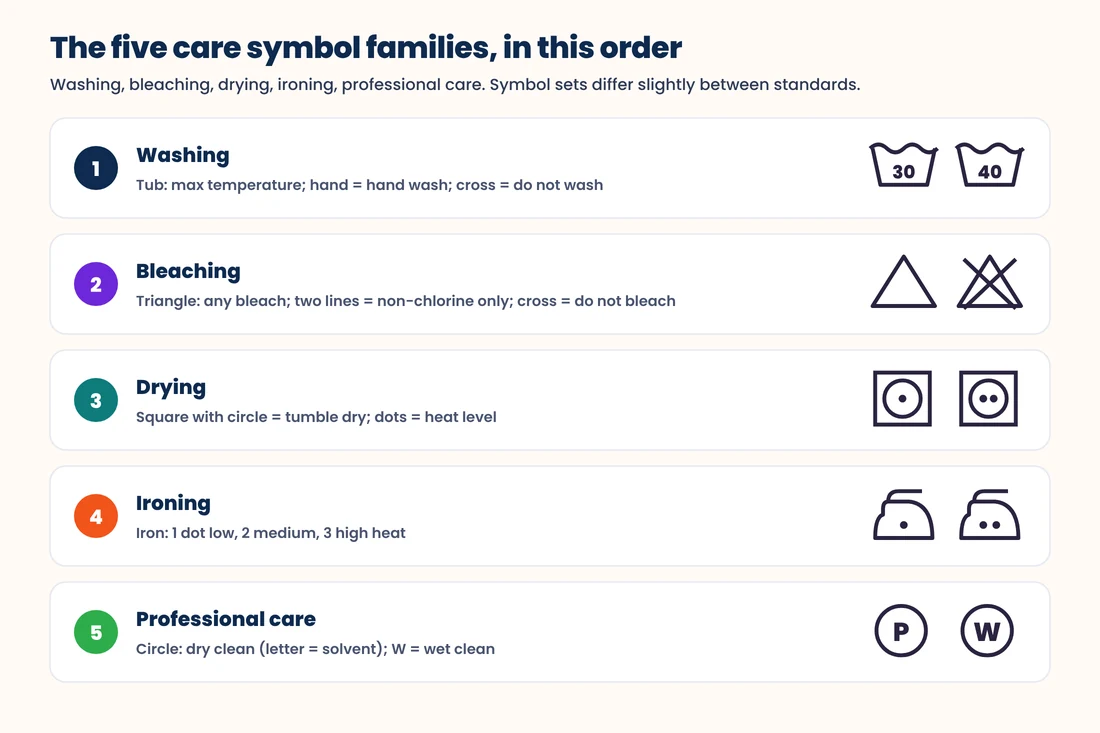
Care symbols let one label work in many markets. There are five families, always shown in this order: washing, bleaching, drying, ironing and professional care.
- Washing (tub): the number is the maximum water temperature in °C; a hand means hand wash; a cross means do not wash.
- Bleaching (triangle): empty triangle means any bleach; two lines inside means non-chlorine bleach only; a cross means do not bleach.
- Drying (square): a circle inside means tumble dry, with dots for heat level; lines mean natural drying.
- Ironing (iron): one dot is low, two medium, three high heat.
- Professional care (circle): letters tell the dry cleaner which solvent to use; W means professional wet cleaning.
The USA uses the ASTM symbol set and Canada its national standard; the UK, EU and Australia use the international (ISO) set. The symbols look almost the same, but check details such as temperature dots against your market. Above all, the care instructions must suit the fabric: ask the factory or a lab to test shrinkage and colour fastness, and base the label on the result. See the fabric quality guide.
What to Send Your Indian Factory
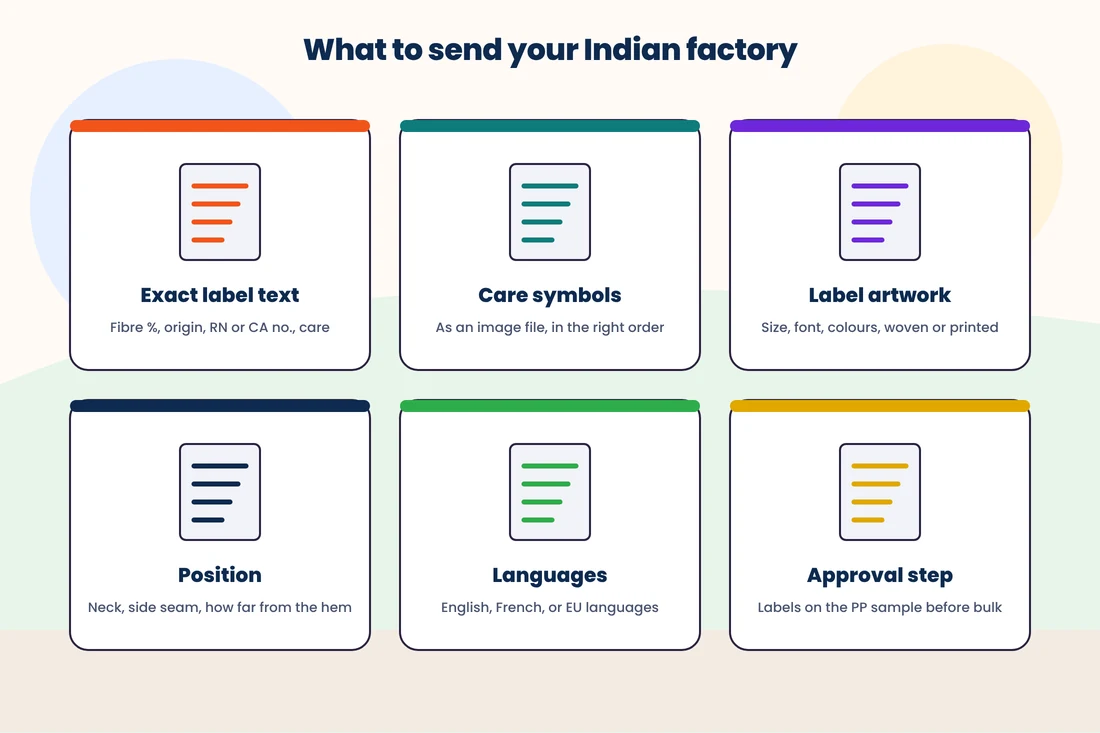
Indian export factories make labels for many markets, but they print what you give them. Put these in your tech pack or the free tech pack template:
- Exact label text for each style and colour: fibre percentages, "Made in India", RN, CA number or company address, size, style number.
- Care instructions and symbols as an image file, in the correct order, matched to the fabric.
- Label artwork: size, font, colours, and whether woven, printed satin or heat transfer.
- Position: neck centre, left side seam, distance from the hem; one label or two.
- Languages: English only, English and French, or several EU languages.
- Swing tags and packaging: price stickers, barcodes, importer details, polybag warnings.
- Approval: labels must be on the pre-production sample, and the inspector checks them again at the pre-shipment inspection.
Ask for the label cost in the quote. Woven labels and multi-language care labels add a little to each piece; see the garment cost sheet guide.
Children's Wear: Extra Rules
Children's clothing carries extra requirements in every market: limits on drawstrings and cords at the neck and waist, small parts such as buttons and decorations, flammability (especially sleepwear), and chemical limits. The USA also requires tracking information on children's products and a Children's Product Certificate based on testing. If you plan children's wear, involve a testing lab and compliance adviser before you design.
Common Labelling Mistakes
- No "Made in India" on goods for the USA, Canada or Australia.
- Brand names instead of generic fibre names, or percentages that do not match the fabric test.
- English only on goods for Canada or an EU country.
- Care instructions copied from another garment, not based on the actual fabric.
- Labels that fade or wash off, or that are too scratchy and get cut out by customers.
- No RN, CA number or importer details where they are required.
- Labels decided after bulk starts, leading to stickers or relabelling abroad.
For the rest of the import process, read the import clothing from India checklist and FOB vs CIF vs DDP.
Frequently Asked Questions
What must a clothing label show in the USA?
Fibre content by percentage, country of origin such as Made in India, the business name or FTC RN number, and care instructions in words or ASTM symbols. The origin goes on a label at the inside centre neck where the garment has one.
What is an RN number?
A Registered Identification Number issued by the US Federal Trade Commission to US businesses. It can be used on labels instead of the company name. The US brand or importer applies for it, and the factory prints it.
What is a CA number in Canada?
A CA Identification Number is a five-digit number preceded by CA, issued to Canadian manufacturers, importers and sellers. It can replace the company name and address on textile labels.
Do clothing labels in Canada need French?
Yes. Fibre names and fibre content must appear in both English and French. Dealer identity and country of origin do not have to be bilingual, though goods sold in Quebec may need more French.
Are care labels required in the UK and EU?
No. Fibre composition labels are required, but care labels are voluntary. Most brands still use care symbols, and any instructions given must be accurate.
Is Made in India required on clothes sold in the UK or EU?
Not on the label, but any origin claim must be true. The USA requires it on the label, and Canada and Australia expect imported clothing to show its country of origin.
Which languages do EU clothing labels need?
Fibre composition must be in the official language or languages of each EU country where the garment is sold, which is why many EU labels list fibres in several languages.
Is care labelling mandatory in Australia?
Yes. The Consumer Goods (Care Labelling) Information Standard 2023 makes care instructions mandatory for clothing and textiles, in English. Imported clothing must also show its country of origin.
What do the care symbols on clothes mean?
There are five families, in order: a tub for washing, a triangle for bleaching, a square for drying, an iron for ironing and a circle for professional cleaning. Dots show heat, numbers show water temperature and a cross means do not.
Who is responsible for clothing labels: the factory or the importer?
Legally, usually the importer or brand selling in the market. The factory prints and sews the labels, so give it the exact text and approve the labels on the pre-production sample.
Can an Indian factory make woven and multi-language labels?
Yes. Export factories in Surat and Ahmedabad regularly make woven, printed and heat-transfer labels. Send the artwork and text with your order and ask for the label cost in the quote.
What extra rules apply to children's clothing?
Limits on drawstrings and small parts, flammability rules for sleepwear and chemical limits. The USA also requires tracking labels and a Children's Product Certificate based on testing.
How do I order private-label clothing with my own labels from India?
Send a brief through BizTorq make-to-order with your designs, quantities and label text. You get a written quote from a verified factory, and labels are approved on the sample before bulk.
Make Your Label, Made in India
Order private-label clothing from verified factories in Surat and Ahmedabad: browse ready designs from 25 pieces or send your brief through make-to-order enquiry with your label text.
Are you a garment exporter? List your factory to receive briefs from brands abroad.
This is a simplified summary for adult clothing, checked in November 2026, and is not legal advice. Labelling rules change; confirm your labels with a customs broker or compliance adviser in your market. Official sources: US Federal Trade Commission (textile and care labelling), Competition Bureau Canada (Textile Labelling Act), UK legislation SI 2012/1102, EU Regulation 1007/2011 and General Product Safety Regulation, and Product Safety Australia (care labelling).