Quick answer
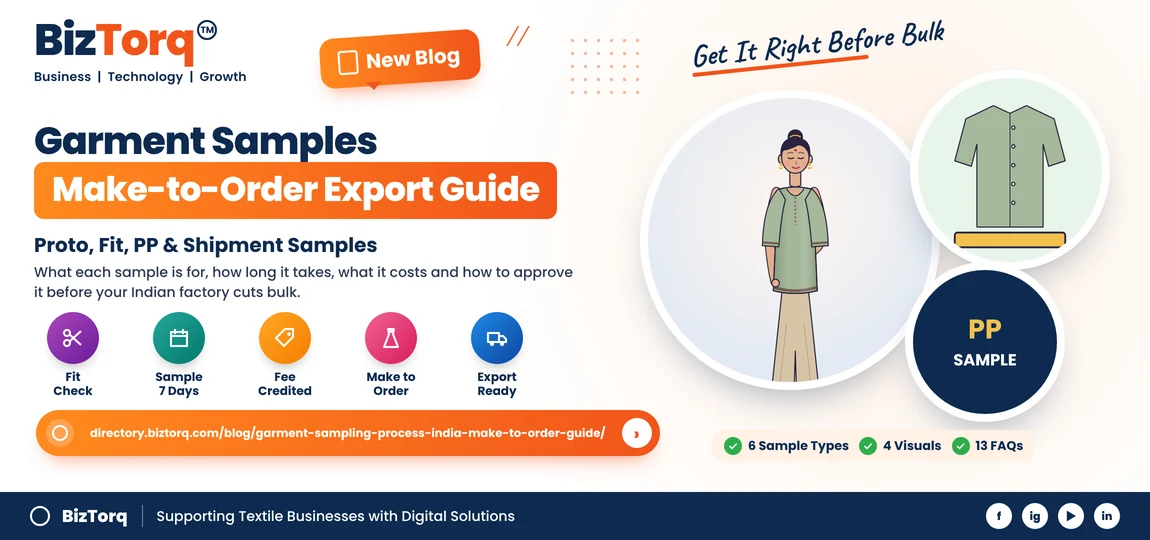
Before an Indian garment factory cuts your bulk order, you approve a sample. Big brands go through up to six: proto (is the design right?), fit (does it fit?), size set (do all sizes grade correctly?), pre-production or PP (made exactly as bulk will be), top of production or TOP (from the first bulk pieces) and shipment (from the packed cartons). A small make-to-order run from a ready design often needs just one sample in your chosen fabric and colour. On BizTorq's ready designs that takes about 7 days, and the sample fee is credited against the bulk order. Allow courier time both ways, and roughly two weeks for every extra round of fit changes.
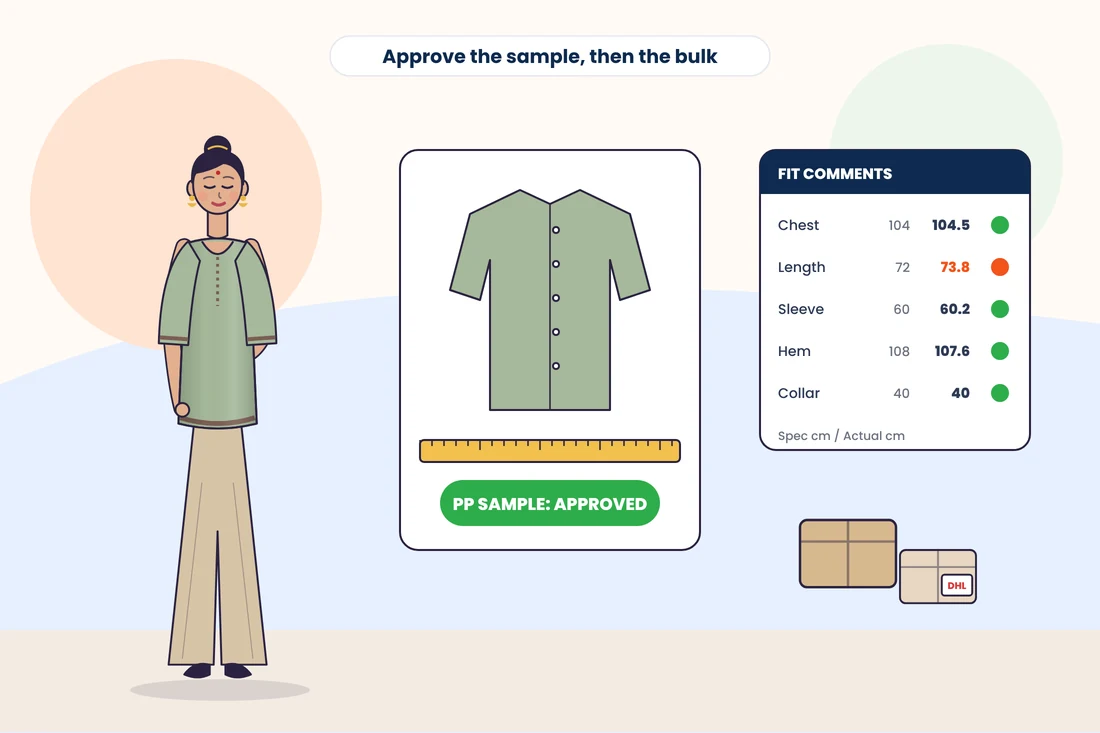
A sample is the cheapest place to find a mistake. A sleeve that is 2 cm too long costs one courier round to fix at sample stage; on 300 finished pieces it costs a rework, a discount or a return. Yet many first-time buyers skip samples to save a week, or approve one from a photo, and then find the bulk is not what they expected.
This guide explains the samples you will meet when you order clothing from a factory in Surat, Ahmedabad or anywhere in India: what each is for, which ones you actually need, how long they take, what they cost, and how to check and approve them from abroad.
Contents
- The six garment samples
- Which samples do you actually need?
- Lab dips, strike-offs and trim approvals
- How long sampling takes
- What samples cost
- How to check a sample at home
- How to approve or reject a sample
- Samples on BizTorq make-to-order
- Common sampling mistakes
- FAQs
The Six Garment Samples
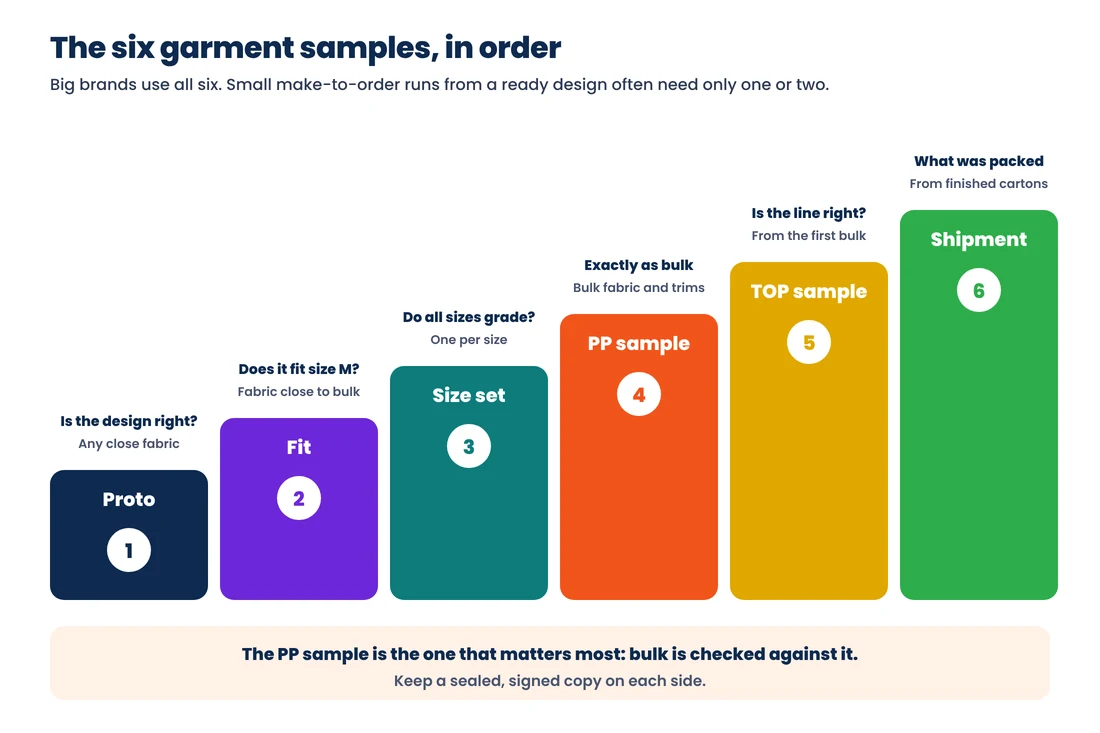
| Sample | Question it answers | Made in | When |
|---|---|---|---|
| Proto (development) | Does the design work: shape, details, proportions? | Any close fabric the factory has | After your tech pack or reference |
| Fit | Does it fit your base size (often M) on a real body? | Fabric close to bulk | After the proto is accepted |
| Size set | Are the other sizes graded correctly? | One piece per size | When you sell a wide size range |
| PP (pre-production) | Is this exactly what bulk will look like? | Bulk fabric, colour, trims, labels and wash | Before bulk cutting |
| TOP (top of production) | Is the production line making it like the PP? | Pulled from the first bulk pieces | Early in bulk |
| Shipment | What exactly was packed? | Pulled from finished cartons | At or after inspection |
You may also hear of salesman or photo samples (a few pieces made early so you can shoot product photos and take pre-orders before bulk arrives) and a counter sample (the factory's copy of an approved sample, kept as its reference). The PP sample is the one that matters most: the bulk is inspected against it, so keep a signed copy on each side.
Which Samples Do You Actually Need?
| Your order | Samples worth doing |
|---|---|
| A ready design, same fabric, your colour and labels, 25 to 100 pieces | One PP-style sample in your colour, with your labels. Video check for small changes. |
| A ready design with fit or length changes | One fit sample, then a PP sample if the changes were large |
| Your own new design from a tech pack | Proto, fit (often two rounds) and PP |
| Wide size range, for example XS to 3XL | Add a size set, or at least the smallest and largest sizes |
| Repeat order of an approved style | No new sample; ask for TOP photos and a shipment sample |
Starting from a design the factory already makes, such as the ready make-to-order designs, saves the most sampling time, because the pattern and fit are already proven.
Lab Dips, Strike-Offs and Trim Approvals
Alongside garment samples, you approve the parts that go into them:
- Lab dip: small pieces of fabric dyed to match your colour reference (a Pantone code or a physical swatch). You choose the closest. Needed when fabric is dyed to your colour; not needed for stock colours.
- Strike-off: a test print of your artwork on the actual fabric, to approve colours and scale before printing metres.
- Wash standard: for denim and garment-dyed pieces, a sample showing the exact wash, which the bulk must match.
- Trim card: buttons, zips, labels, hang tags and thread colours on one card, so nothing is swapped in bulk.
- Fabric approval: a swatch of the bulk fabric with its weight (GSM or oz) and composition.
Check colours in daylight, not only on a phone screen. For fabric checks, see the fabric quality guide, and for printing and dyeing in Surat, the printing and dyeing guide.
How Long Sampling Takes
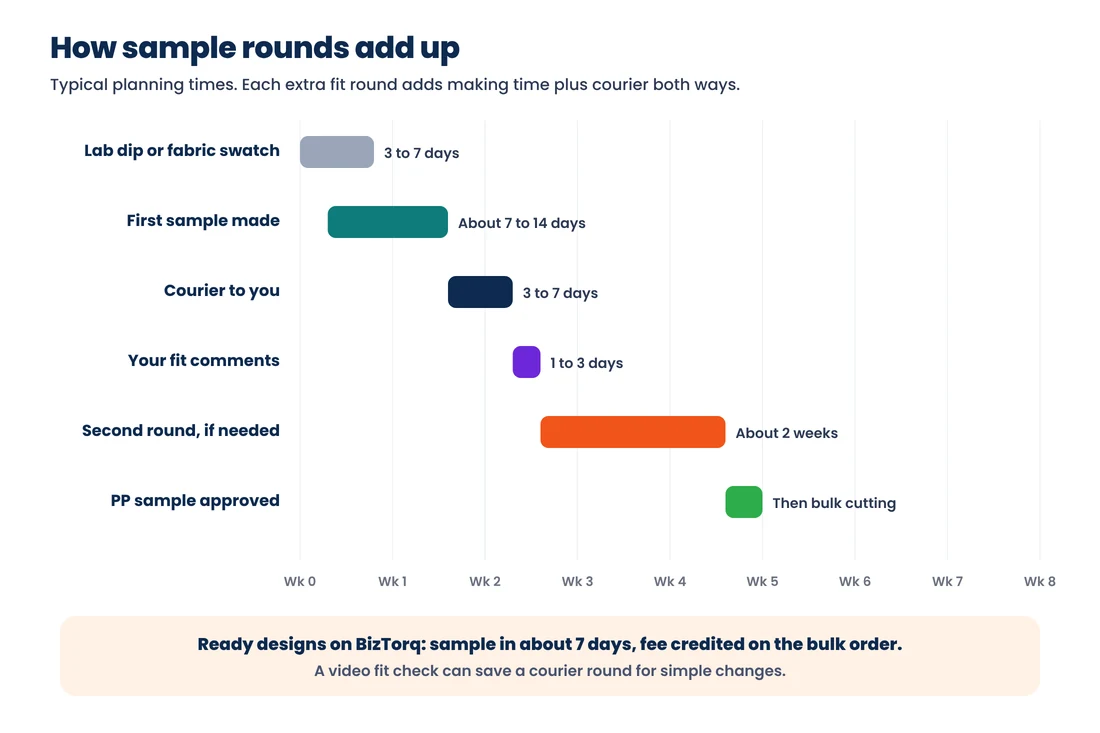
- Lab dip or fabric swatch: about 3 to 7 days, if needed.
- First sample: about 7 to 14 days for a new design. BizTorq's ready designs state about 7 days.
- International courier: about 3 to 7 days each way to the USA, UK, Europe, Australia or the UAE, plus customs clearance.
- Your comments: 1 to 3 days if you are organised. This is often where weeks are lost.
- Each extra round: roughly 2 weeks including making and courier.
A new design with two fit rounds and a PP sample can easily take 4 to 6 weeks before bulk starts. Work backwards from your launch date with the timeline planner.
What Samples Cost
A sample takes the same pattern work, cutting and setup as a whole run, for one piece, so it costs far more per piece than bulk. Expect:
- Sample fee: set by each factory. Many charge a fee that is credited against the bulk order if you go ahead, which is the case on BizTorq's ready designs. Others charge a fixed amount per style.
- Pattern charge: sometimes added for a completely new design.
- Lab dips and strike-offs: sometimes free, sometimes charged, especially for prints.
- Courier: international express costs for a small parcel, often more than the sample itself. Ask whether you pay the factory or use your own courier account.
- Import duty on samples: samples are usually still dutiable. In the USA the low-value duty-free exemption has been suspended for all countries since August 2025, so even one-piece parcels can face duty and a broker fee.
Get every sample term in the written quote before you pay: fee, credit on bulk, number of rounds included, and courier. To see how samples fit into your overall budget, read the garment cost sheet guide.
How to Check a Sample at Home
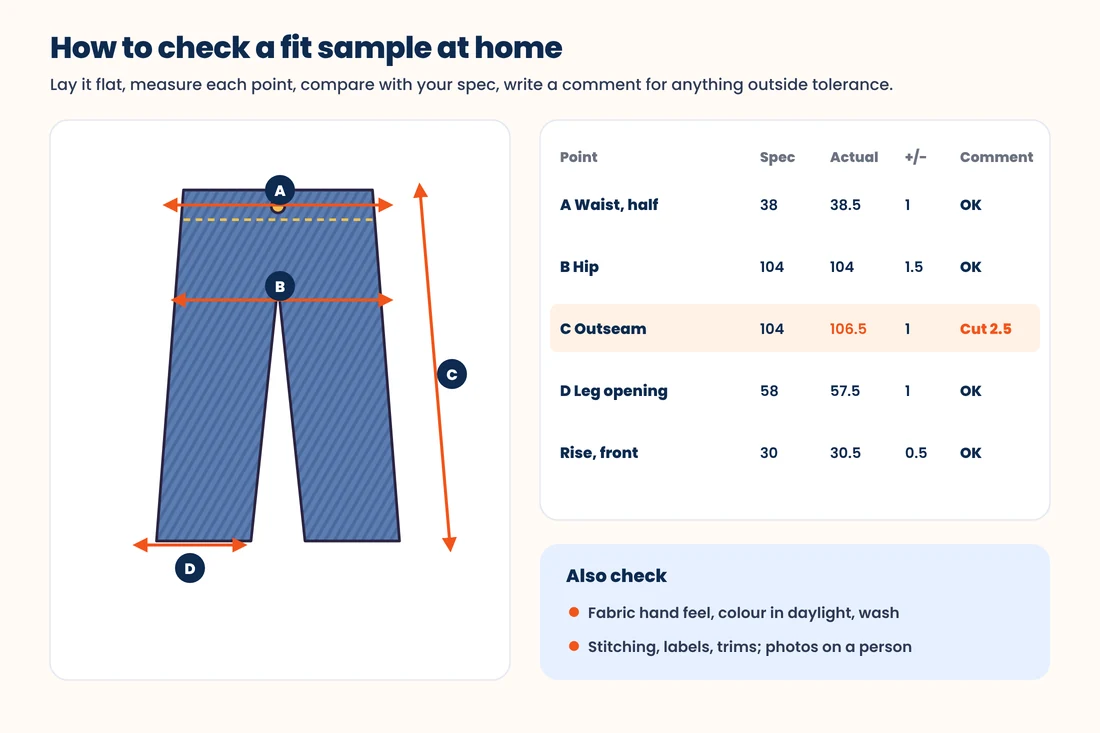
- Measure it flat. Lay the garment on a table and measure every point in your size chart: chest or waist, hip, length, sleeve, leg opening. Write spec, actual and difference.
- Compare with tolerance. Agree tolerances in your tech pack, for example about plus or minus 1 cm on main measurements. Only comment on what is outside.
- Try it on a person who matches your base size. Take front, side and back photos; check movement, sitting, arms raised.
- Check fabric and colour in daylight against your reference: hand feel, weight, shade, wash.
- Check workmanship: seams, stitch density, loose threads, buttonholes, zip, inside finishing.
- Check branding: neck label, care and content label, hang tag, packing.
- Wash it once if you can, and measure again to see shrinkage.
How to Approve or Reject a Sample
Write your decision clearly, in one message or sheet, with three possible results:
- Approved: bulk can be cut exactly like this sample.
- Approved with comments: bulk can go ahead with the listed small changes; no new sample needed.
- Rejected, resubmit: make a new sample with the listed changes.
Number each comment, give the measurement in centimetres or inches, and add a marked-up photo. Keep the approved sample sealed and labelled, and ask the factory to do the same with its counter sample. At pre-shipment inspection, the inspector compares bulk with this approved sample; see the AQL 2.5 inspection guide.
Approving remotely: for small changes on a design the factory already makes, a live video call where the factory measures the sample on camera can save a full courier round. For a new fit, always get the physical sample.
Samples on BizTorq Make-to-Order
On BizTorq make-to-order, you send a brief, receive a written quote from a verified factory in Surat or Ahmedabad and contract with it directly. The ready designs in the make-to-order range state a sample in about 7 days, a sample fee credited on the bulk order, and bulk in about 20 days after approval, from 25 pieces per design. When you send your brief:
- say which design, colour and size you want sampled;
- list any changes (fabric, length, fit, trims, labels);
- attach your size chart or a tech pack;
- give your courier address and whether you have your own courier account;
- ask the factory to confirm the sample fee, credit and number of rounds in writing.
For the full ordering process, read the make-to-order export guide and how to start a clothing brand with an Indian manufacturer.
Common Sampling Mistakes
- Approving from photos only for a new fit or fabric.
- Vague comments such as "make it a bit looser" instead of "add 2 cm to the chest".
- Changing the design after the PP sample, which restarts sampling.
- Not sampling in the bulk fabric, then finding the bulk drapes or shrinks differently.
- Forgetting labels and packing on the PP sample, so branding errors appear only in bulk.
- Slow replies: a week of silence after a sample arrives is a week off your launch date.
- No sealed sample: without one, there is nothing to hold the bulk to.
Frequently Asked Questions
What are the types of samples in garment manufacturing?
The main ones are proto (development), fit, size set, pre-production (PP), top of production (TOP) and shipment samples. Salesman or photo samples and counter samples are also common.
What is a PP sample?
A pre-production sample is made in the bulk fabric, colour, trims, labels and wash, exactly as bulk will be. Once approved, it is the standard the bulk order is inspected against.
What is the difference between a proto sample and a fit sample?
A proto sample checks the design itself and can be made in any close fabric. A fit sample checks how the garment fits your base size on a real body, in fabric close to the bulk.
How many samples do I need for a small make-to-order order?
For a ready design in the factory's fabric, often just one sample in your colour with your labels. A new design from a tech pack usually needs a proto, one or two fit rounds and a PP sample.
How long does a garment sample take in India?
About 7 to 14 days for a new design, plus courier time both ways. BizTorq's ready make-to-order designs state about 7 days. Each extra fit round adds about 2 weeks.
How much does a garment sample cost?
Each factory sets its own fee, and a sample costs far more per piece than bulk. Many factories credit the sample fee against the bulk order. Courier and import duty are usually extra.
Is the sample fee refundable?
Usually not as cash, but many factories credit it against the bulk order if you go ahead. Ask for the credit terms in the written quote before paying.
What is a lab dip?
Small fabric pieces dyed to match your colour reference, for example a Pantone code. You pick the closest match before the factory dyes bulk fabric. It is not needed for stock colours.
What is a size set sample?
One sample in each size, or at least the smallest and largest, to check that the pattern grades correctly across your size range.
Can I approve a garment sample by video?
For small changes on a design the factory already makes, a live video where the factory measures the sample can save a courier round. For a new fit or fabric, get the physical sample.
Do I pay customs duty on clothing samples from India?
Usually yes. Samples are generally dutiable, and in the USA the low-value exemption has been suspended since August 2025. Check with your courier or customs broker.
What should I write in fit comments?
Number each point, give the spec, the actual measurement and the change wanted in centimetres or inches, and add marked-up photos. Avoid vague words like looser or shorter.
How do I get a sample from a make-to-order factory on BizTorq?
Choose a design from the make-to-order range or send a brief through make-to-order enquiry, with the colour, size, changes and courier details. The factory confirms sample terms in its written quote.
Order a Sample from a Verified Factory
Pick a design from the make-to-order range or send your own through make-to-order enquiry. Ready designs: sample in about 7 days, fee credited on bulk.
Are you a garment factory in Surat or Ahmedabad? List your factory to receive briefs from brands abroad.
Times and terms are typical planning figures; sample fees, rounds and lead times are set by each factory in its written quote. Confirm import duty on samples with your courier or customs broker.